Article 07
12 May 2026
Speed vs. Direction
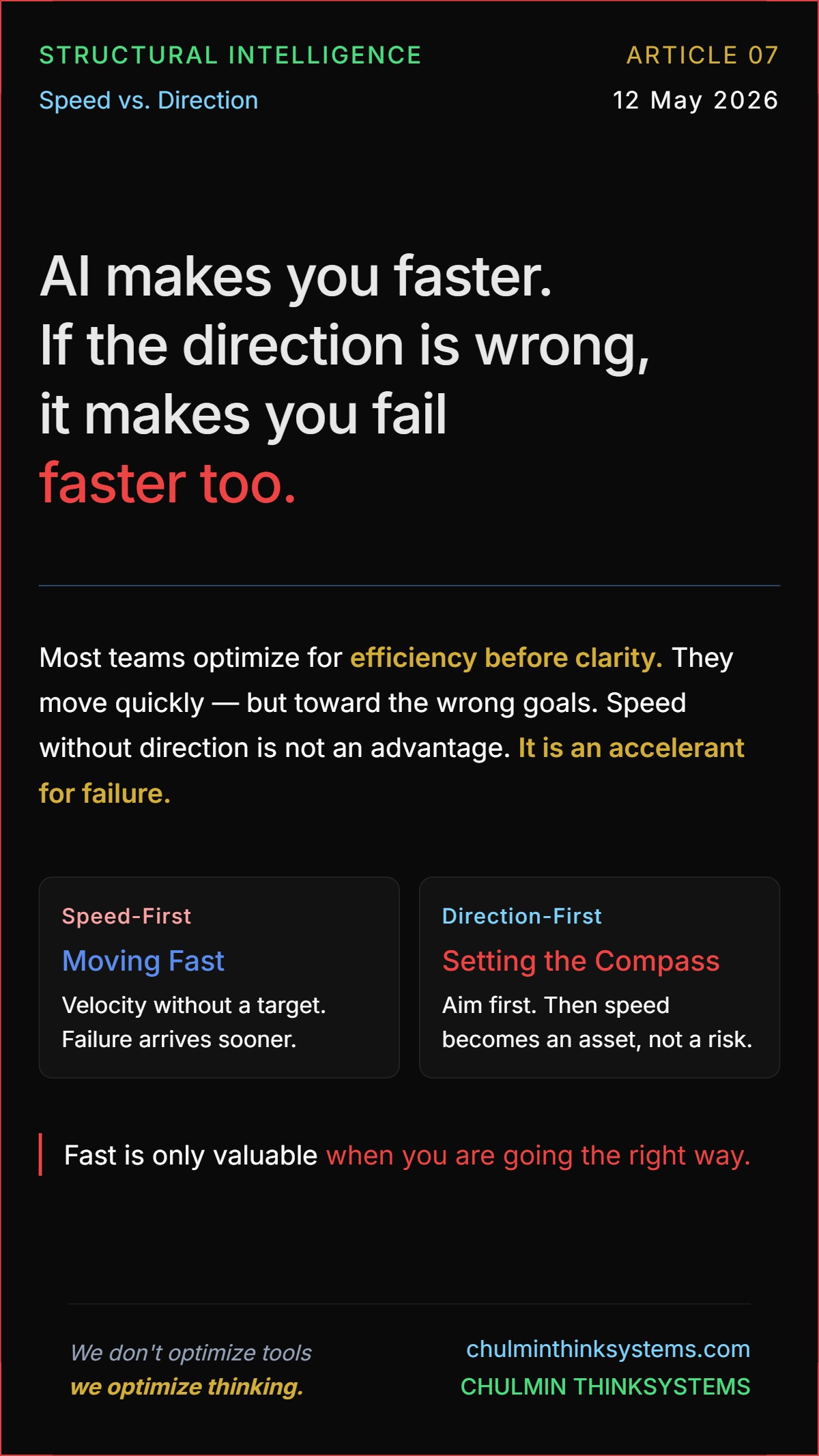
AI makes you faster. If the direction is wrong, it makes you fail faster too.
Most teams optimize for efficiency before clarity. They move quickly — but toward the wrong goals. Speed without direction is not an advantage. It is an accelerant for failure.
Speed-First is velocity without a target — failure arrives sooner. Direction-First aims first, then makes speed an asset, not a risk.
Fast is only valuable when you are going the right way.
Article 06
5 May 2026
The Hidden Cost of "Smart" Systems
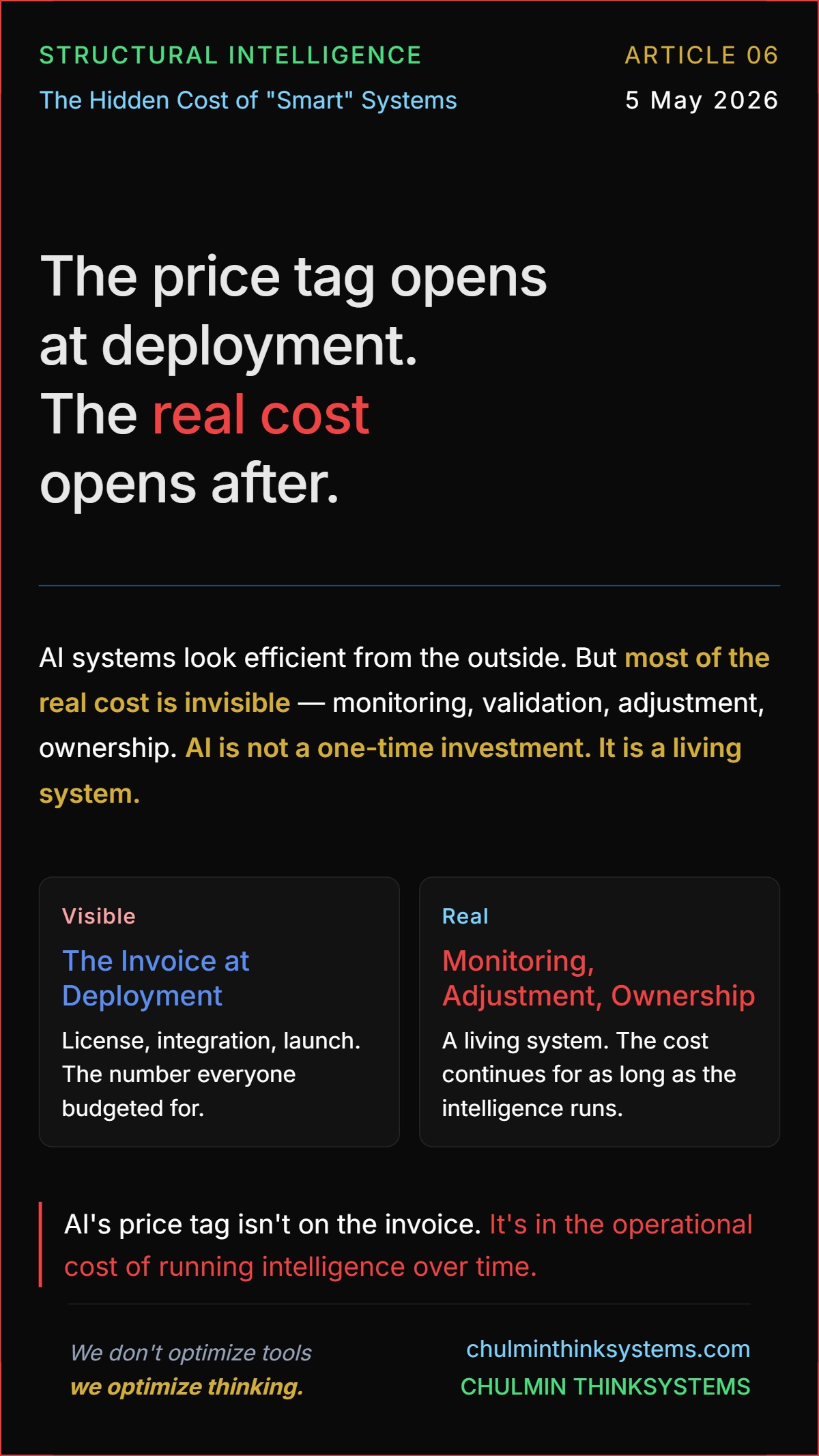
The price tag opens at deployment. The real cost opens after.
AI systems look efficient from the outside. But most of the real cost is invisible — monitoring, validation, adjustment, ownership. AI is not a one-time investment. It is a living system.
The visible cost is the invoice at deployment — license, integration, launch. The real cost is monitoring, adjustment, and ownership — and it continues for as long as the intelligence runs.
AI's price tag isn't on the invoice. It's in the operational cost of running intelligence over time.
Article 05
28 Apr 2026
Data Doesn't Create Intelligence
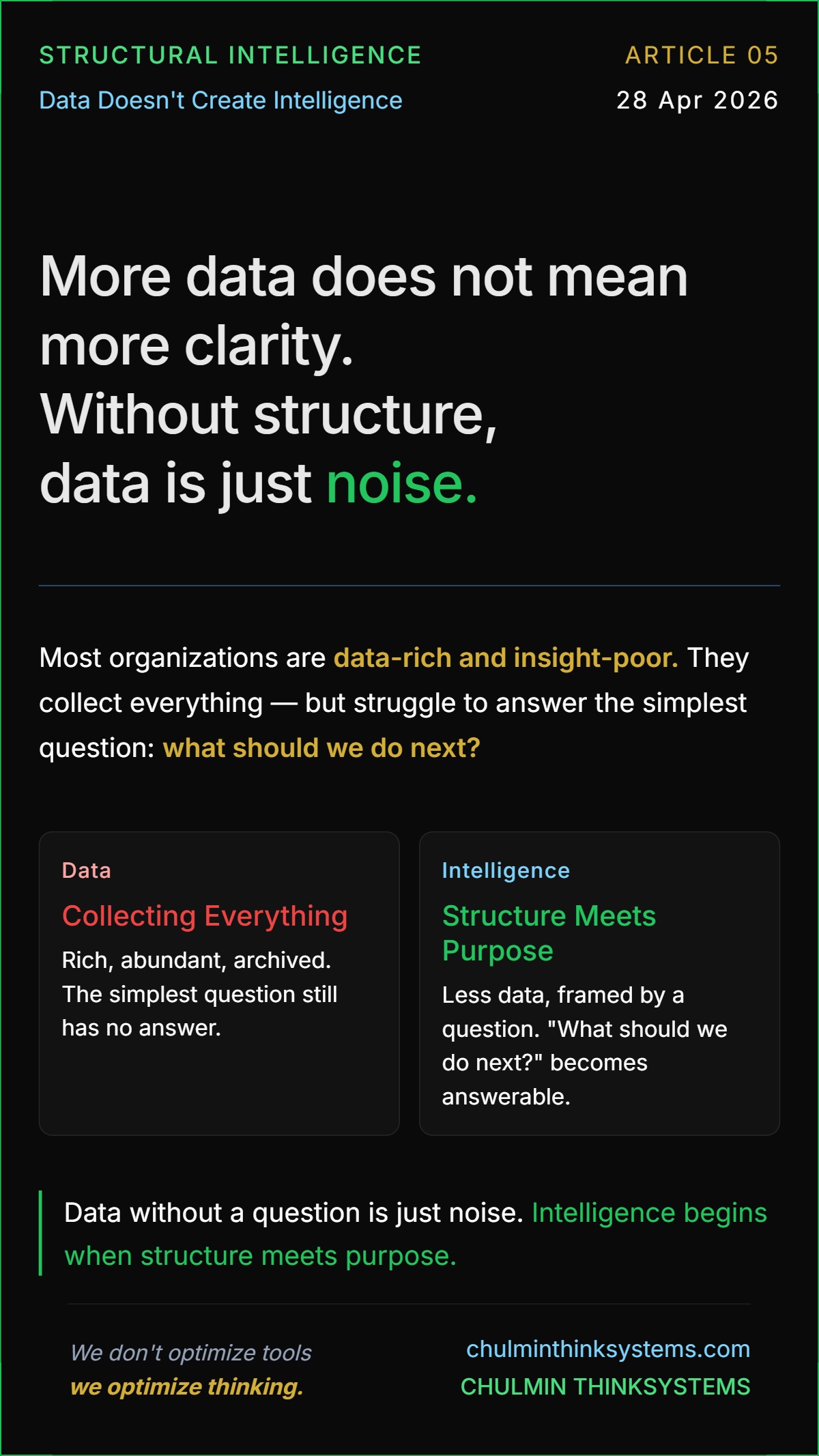
More data does not mean more clarity. Without structure, data is just noise.
Most organizations are data-rich and insight-poor. They collect everything — but struggle to answer the simplest question: what should we do next?
Data is collection — rich, abundant, archived, and the simplest question still has no answer. Intelligence is less data, framed by a question — and "what should we do next?" becomes answerable.
Data without a question is just noise. Intelligence begins when structure meets purpose.
Article 04
21 Apr 2026
The Illusion of Automation
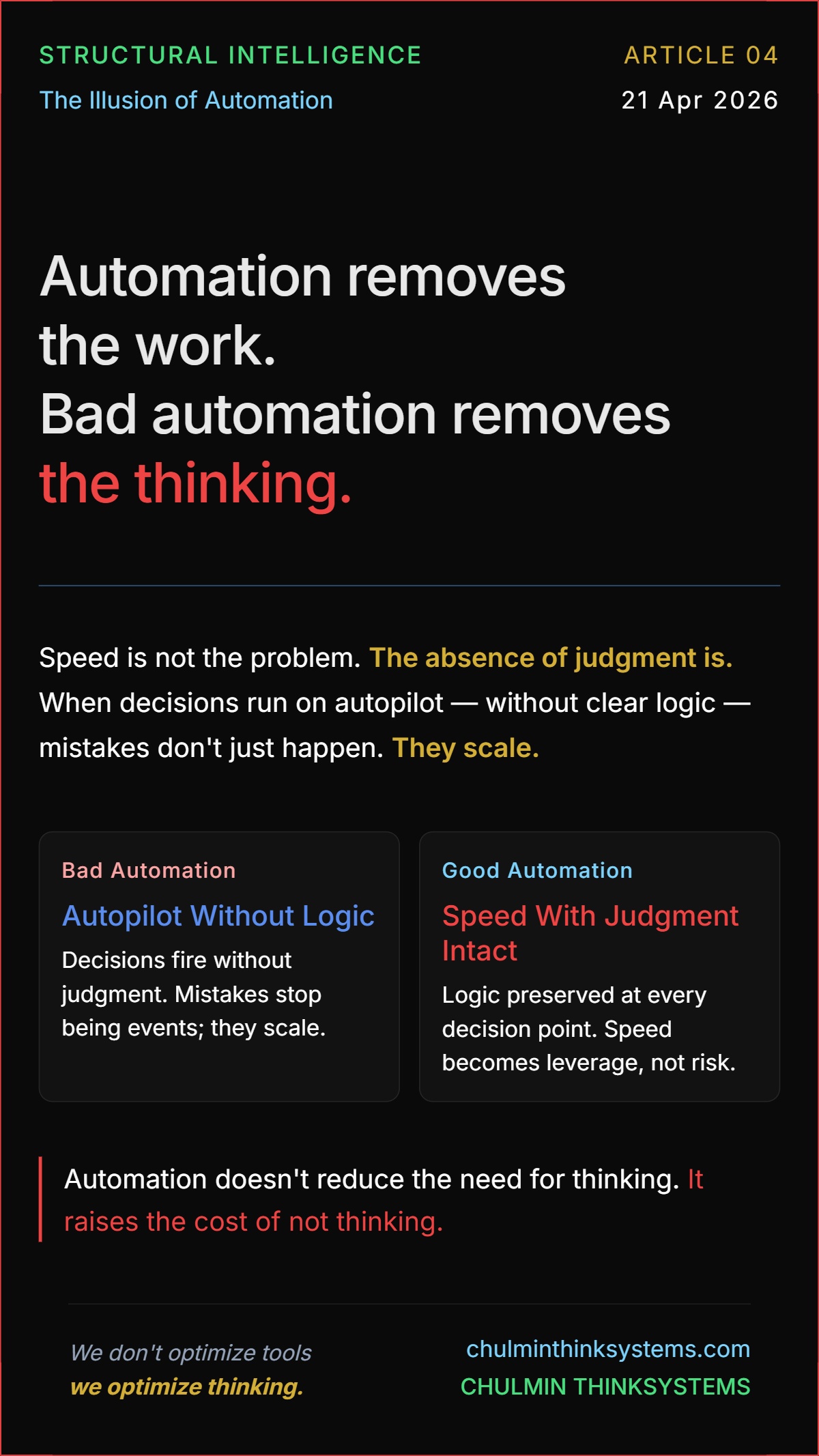
Automation removes the work. Bad automation removes the thinking.
Speed is not the problem. The absence of judgment is. When decisions run on autopilot — without clear logic — mistakes don't just happen. They scale.
Bad automation is autopilot without logic — decisions fire without judgment, and mistakes stop being events; they scale. Good automation preserves logic at every decision point — speed becomes leverage, not risk.
Automation doesn't reduce the need for thinking. It raises the cost of not thinking.
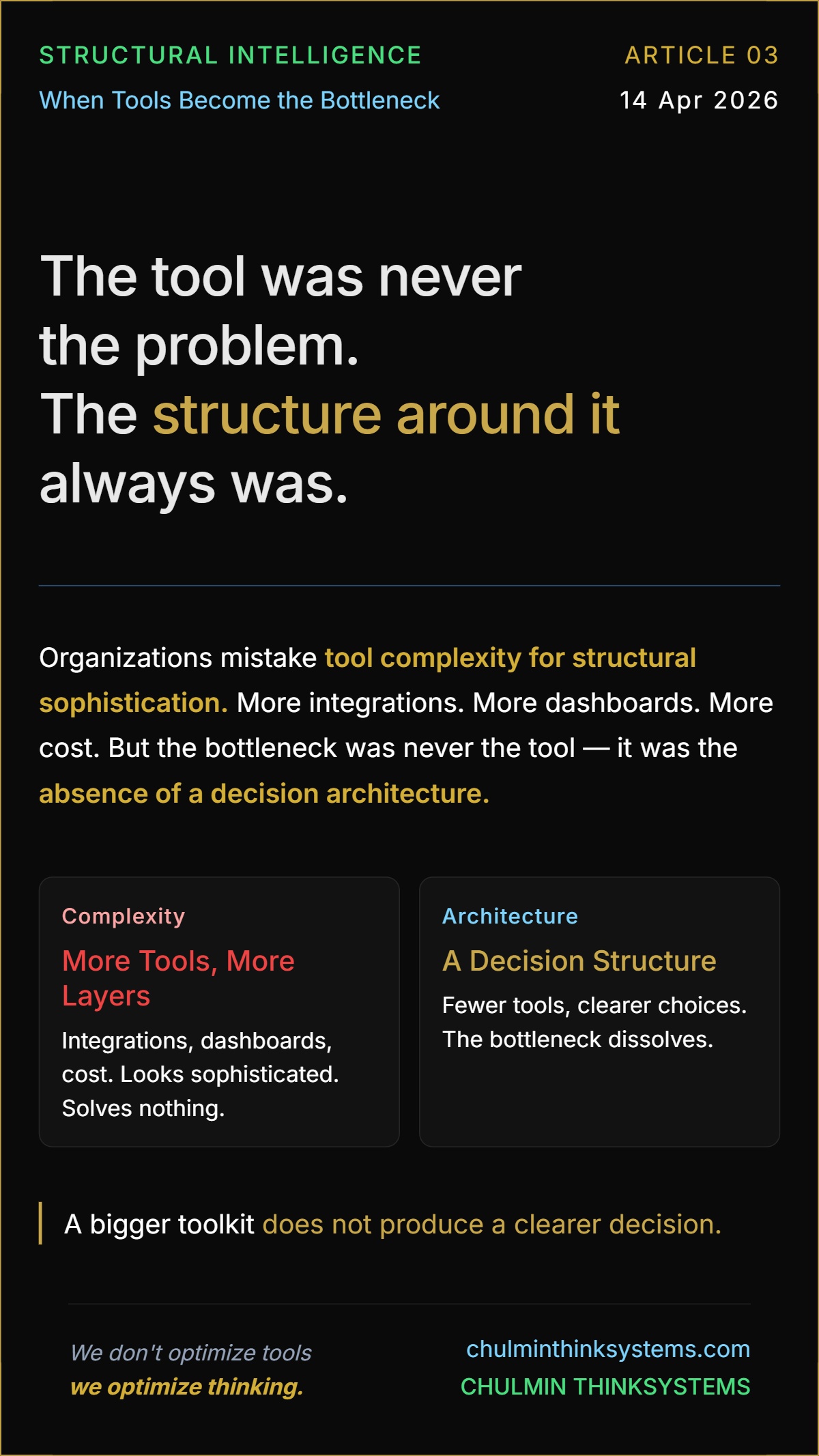
Article 03
14 Apr 2026
When Tools Become the Bottleneck
The tool was never the problem. The structure around it always was.
Organizations mistake tool complexity for structural sophistication. More integrations. More dashboards. More cost. But the bottleneck was never the tool — it was the absence of a decision architecture.
Complexity means more tools, more layers — integrations and dashboards that look sophisticated but solve nothing. Architecture means fewer tools, clearer choices — and the bottleneck dissolves.
A bigger toolkit does not produce a clearer decision.
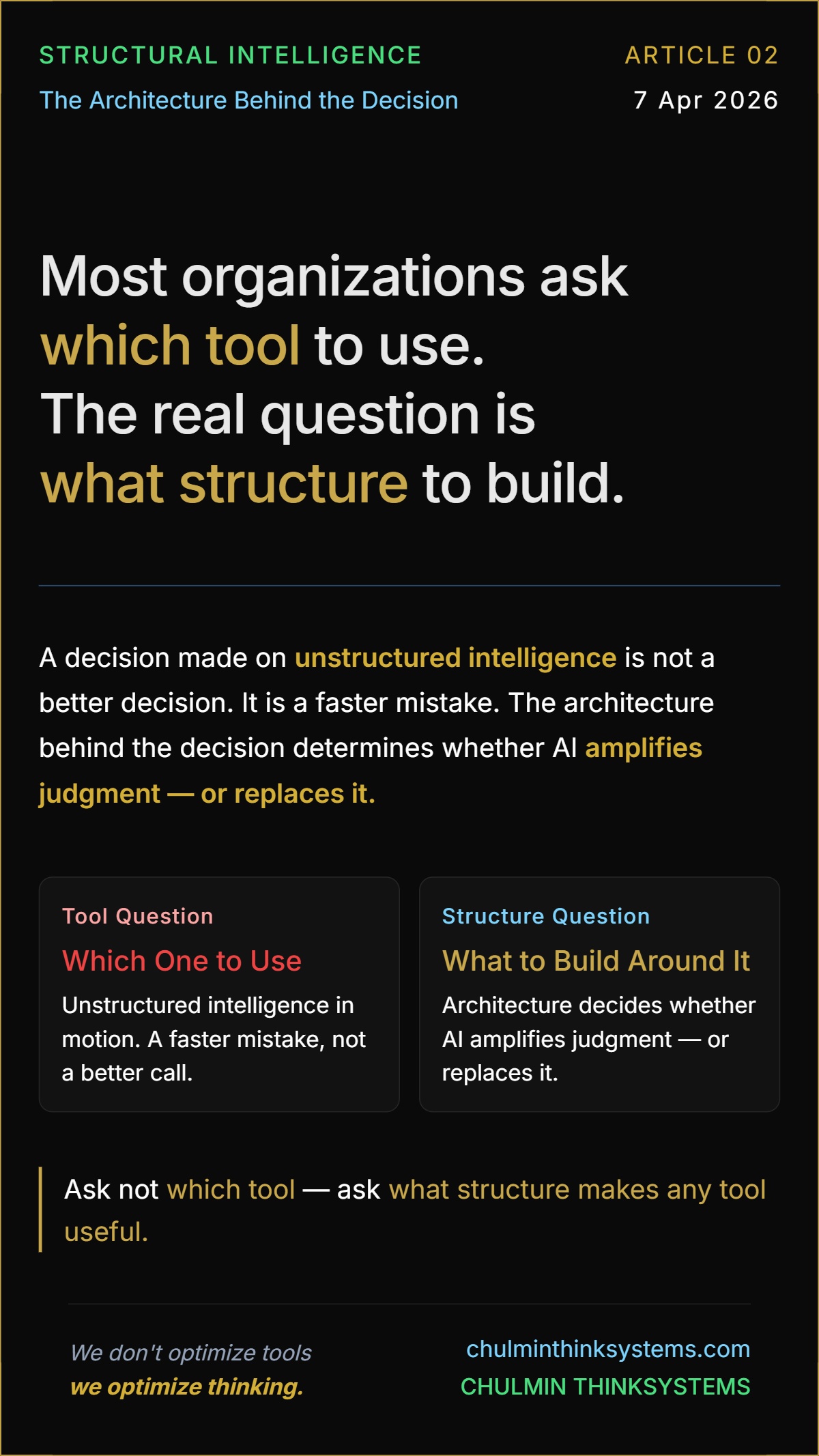
Article 02
7 Apr 2026
The Architecture Behind the Decision
Most organizations ask which tool to use. The real question is what structure to build.
A decision made on unstructured intelligence is not a better decision. It is a faster mistake. The architecture behind the decision determines whether AI amplifies judgment — or replaces it.
The tool question — which one to use — is unstructured intelligence in motion: a faster mistake, not a better call. The structure question — what to build around it — is what decides whether AI amplifies judgment or replaces it.
Ask not which tool — ask what structure makes any tool useful.
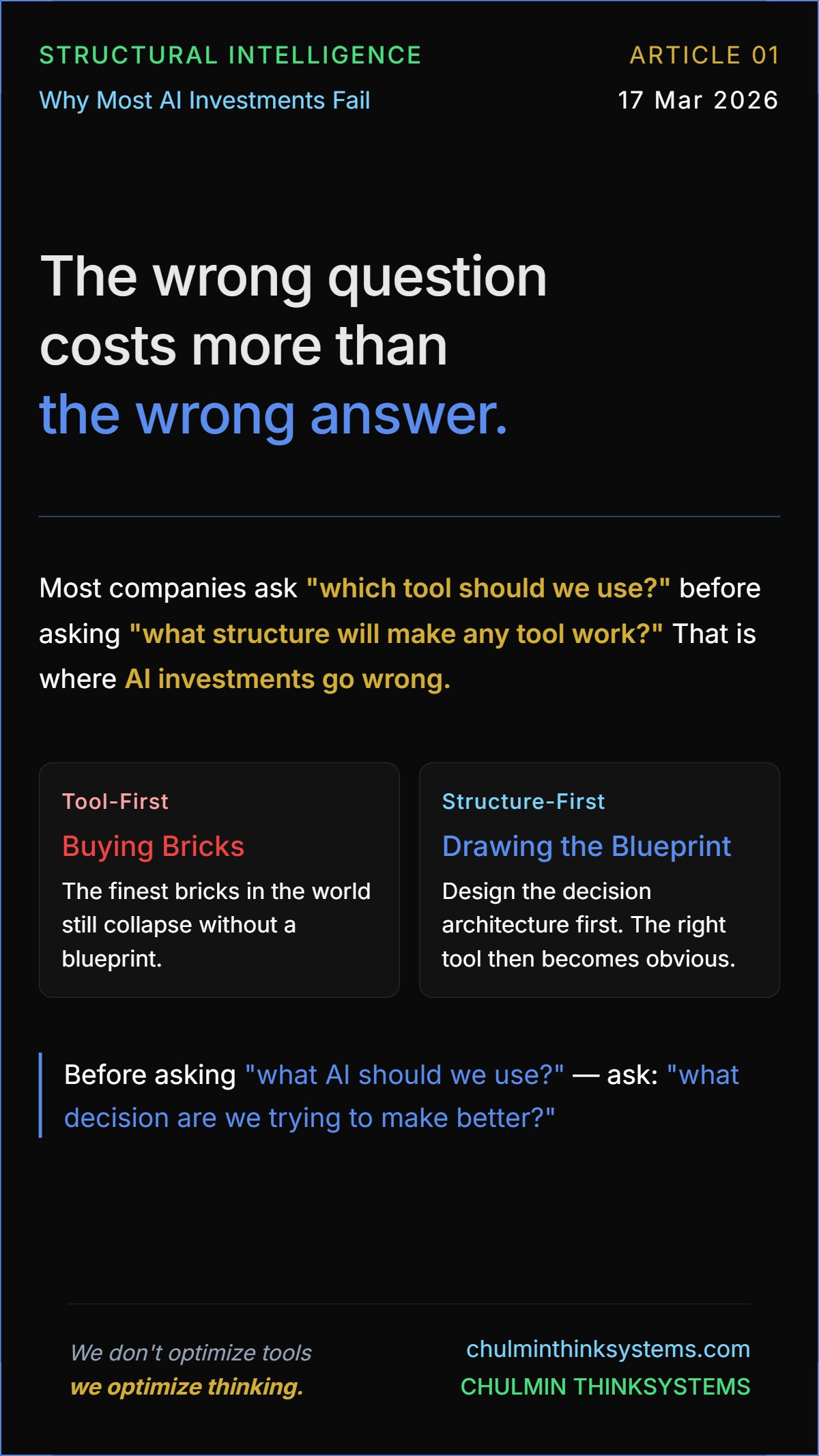
Article 01
17 Mar 2026
Why Most AI Investments Fail
The wrong question costs more than the wrong answer.
Most companies ask "which tool should we use?" before asking "what structure will make any tool work?" That is where AI investments go wrong.
Tool-First is buying bricks — the finest bricks in the world still collapse without a blueprint. Structure-First designs the decision architecture first, and the right tool then becomes obvious.
Before asking "what AI should we use?" — ask: "what decision are we trying to make better?"